For allied & mental health clinicians
Join the team that GPs trust with their most complex patients.
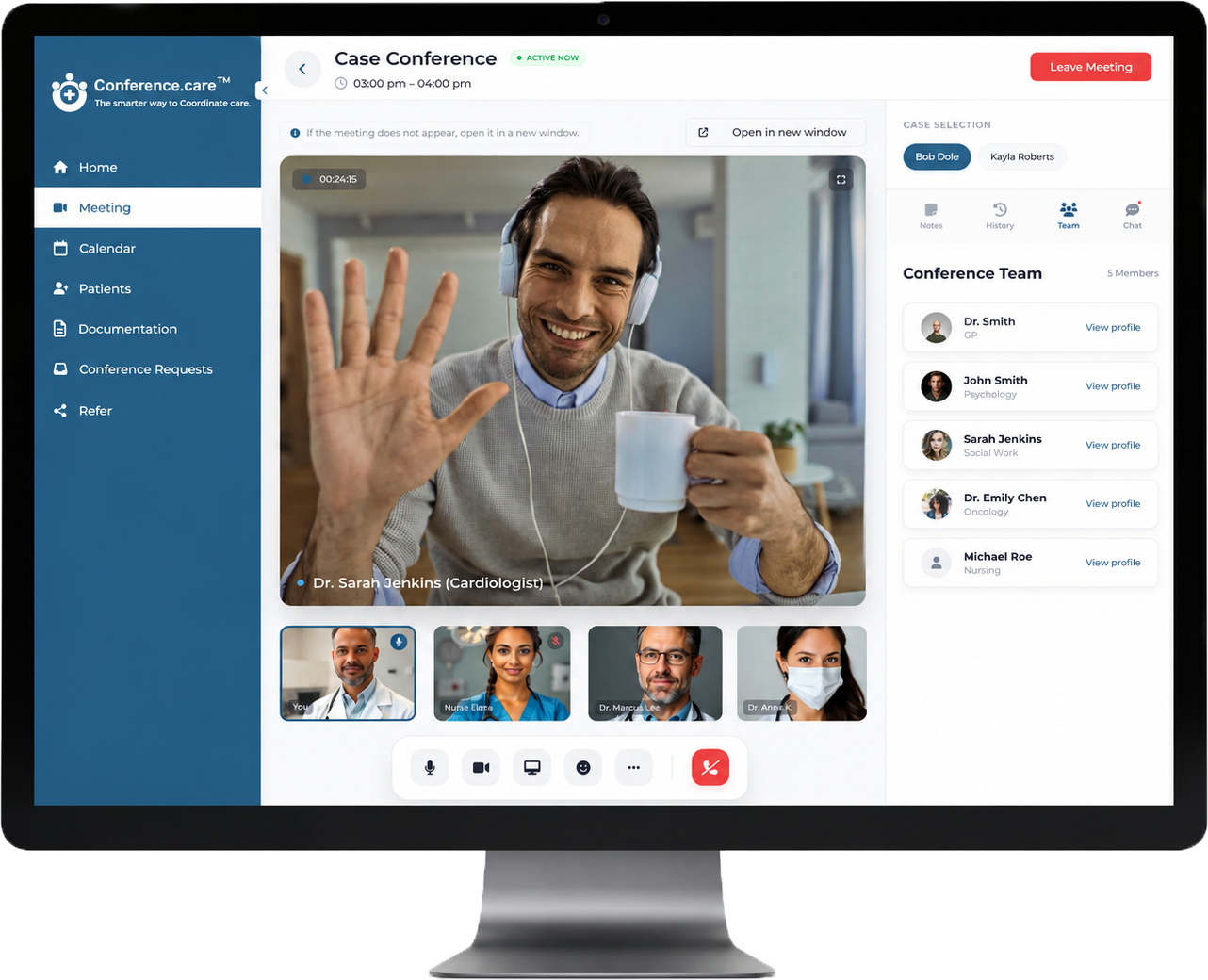
Conference.care places you into Medicare-funded case conferences alongside other clinicians. You advise the patient’s doctor directly, develop new professional relationships and receive the referrals that follow.
Real multidisciplinary work, on the days and hours you choose.
No cost to join · No quota · Decline anything that doesn’t suit.
in Australia
that suit you
Indicative only — not financial or clinical advice. Conference duration, frequency and composition remain clinical decisions for the coordinating practitioner.
Trusted by health practitioners across Australia
















See it in action
Case conferencing, explained
The problem
Care is shared. Information isn’t.
A patient with a chronic condition is usually seeing a GP and two or more other clinicians. Everyone works independently, reporting in to the GP and hearing nothing back. The GP is left to join the dots alone.
Australians see three or more health professionals for the same condition — usually without those professionals ever speaking.
of them report problems caused by poor communication between care providers.
Correspondence was built for one clinician writing to another. It carries a finding in one direction, on a delay, and gives nobody a way to hear how anyone else is thinking about the case.
What a case conference is
All the patient needs, in one conversation
A case conference is a scheduled discussion between a patient’s GP and several health professionals about a patient with complex or chronic needs. It runs online, it is funded by Medicare, and the patient does not attend.
The GP presents the case. You advise, and hear everyone else’s professional opinion. What the psychologist says about the patient’s sleep may change what the physiotherapist suggests for their exercise plan. That does not happen with regular correspondence.
The GP takes the advice away and decides what to do with it. They also come away knowing exactly how you think about a case, which is the part that matters for what happens next.

Why join
Collaborative care that counts
Your expertise means more in a conversation than it ever does on paper. Working with Conference.care, you contribute alongside experts from other disciplines, helping the GP decide the best path of care for their patient in real time.
Your knowledge, put to use
We bring you in when a GP needs your advice on a case. They brief you, you provide your professional opinion, and it directly influences their decisions on the patient’s care.
Work that leads to more work
GPs refer based on the experience of working with our clinicians. Once they see how much the discipline adds to a patient’s care, that trust becomes a referral pathway — which can also bring you more work directly with patients.
Same patient, same page
Every conference puts you alongside a GP and clinicians from other disciplines on the same patient. You hear how they reason, they hear how you do, and the case gets thought through together.
You can take it, or leave it
Take the conferences that suit your week and decline the rest. No unrealistic expectations, no pressure — how much you take on is entirely up to you.
Rise through the ranks
Certify as a conference lead when you’re ready. You’ll guide the discussion instead of only contributing to it — real progression, not just more sessions.
Practise without walls
No rooms, no travel, no caseload to carry. You do this from wherever you already are, around whatever else you’re doing.
Who we’re looking for
GPs are asking for these disciplines
If you’re an allied or mental health professional with current AHPRA or professional registration, apply to join us today.
Regular work
Practice makes perfect
GPs often elect to run conferences in a standing weekly slot, cycling their complex patients through it. Take that slot and you’re on the same call with the same team regularly — which is how a GP comes to know your work rather than your name.
The knock-on effect
Word travels fast. So do referrals.
In a case conference, a GP gets to consult with some of the best clinicians in Australia. That quality bar is what drives follow-up referrals — and brings you long-term benefits to joining Conference.care.
-
Your details are already in front of them
Your location, your wait times, whether you do telehealth and what you charge — so the question of whether you can take the patient is answered before it’s asked.
-
Referring takes one click
Straight from the Conference.care portal, while the case is still front of mind — not a letter that has to be written later, or not at all.
-
The GPs you meet are near you
You’re assigned to conferences with practices in your area — so when a GP decides to refer, their patient can actually get to you.
-
And it all adds up
Take a practice’s conferences regularly and you become the clinician they think of first in your discipline — because they have worked with you, repeatedly, on their own patients.
The evidence
Better care, backed by research
Studies consistently show that when care teams meet like this, patients' problems are picked up earlier, care plans work better, and hospital visits go down.

of Australian patients in a recent study believe case conferences had a positive effect on their care.
Across many health settings, research consistently shows case conferences:
- Ensure patient problems are properly identified
- Generate more effective care plans
- Enhance clinical decision-making
- Reduce hospitalisations & ED presentations
- Improve symptom management and quality of life
- Reduce overall healthcare costs
The policy consensus
Team-based care isn’t a pipe dream — it’s the direction of travel
Every national primary care document in recent years says the same thing, and allied health is named in all of them.
Patients should be able to access evidence-based multidisciplinary care through team-based primary care models, led by their GP.
Australian Medical Association
Vision for Australia’s Health 2024–2027General practice must evolve to include multidisciplinary GP-led team-based models of care, supported by technology — particularly for people with chronic and complex conditions.
Royal Australian College of General Practitioners
Vision for General PracticeOur funding systems need to more effectively support multidisciplinary team-based care models in primary care and break down barriers to interprofessional collaboration.
Australian Government Department of Health
Strengthening Medicare Taskforce Report, December 2022Funding arrangements will continue to be reviewed to ensure multidisciplinary team-based care becomes an embedded feature of primary health care.
Australian Government Department of Health
Primary Health Care 10 Year Plan 2022–2032Who’s behind it
Supported by a clinician-led team
Conference.care was founded and is run by Australian GPs. You get direct access to that team for help with the clinical, administrative and Medicare-compliance side of case conferencing — whenever you need it.

Dr Daniel Nguyen
Co-founder · FRACGP General Practitioner

Dr Chris Mitchell AM
Advisory board · Former RACGP federal president

Trent Raykos
Head of Allied Health · Physiotherapist

Jerome Gillbard
Psychologist
Compliance & security
Built with Australia’s medical defence lawyers
Developed in consultation with Avant Law, the legal arm of Australia's largest medical defence organisation, so compliance is handled as a forethought, not an afterthought.

Supports Medicare compliance
- Automatically allocates the correct time-tiered item number
- Automatic time & participant logging
- Full audit trail and documentation
- Flags teams that don't meet the requirements
Australian Privacy Act aligned
- Built to the Australian Privacy Principles
- Strict role-based access controls
- Minimal data retention
Healthcare-grade security & infrastructure
- Encrypted in transit and at rest
- Securely hosted in Australia
- Independent security audits
Getting started
One form, one review, then the job comes your way
-
1
Sign up and complete onboarding
The portal walks you through the process — AHPRA registration, current indemnity insurance, register a Medicare provider number, your disciplines and the agreements.
-
2
We review it — usually within a day
A real person reads every application. We check your registration, insurance and experience — the GPs we work with expect a top team, and this is how we help maintain the standard.
-
3
You are matched with GPs near you
Deliberately local — so when a GP decides to refer afterwards, their patient can easily reach you.
-
4
Offers to participate come to you
Each one shows the patient’s presenting problems, the time, and who else is on the team. Take the ones that suit your schedule and start conferencing.
Joining costs nothing, and you only take the conferences that suit you.
Questions
Allied health frequently asked questions
Can I participate if I haven’t met the patient?
Yes. The MBS explanatory note for these items says it directly: “The health professional is not required to have a pre-existing relationship with the patient.” A referral isn’t required either. Where the patient does already have a treating clinician in your discipline, that clinician is invited first.
Will I get referrals out of it?
That’s the GP’s decision — and working a case through with you tells helps them see the benefit your expertise brings to the patitent's care. From there we remove the friction: your wait times, fees and availability are on screen while they’re deciding, referring is a single click from the conference record, and conferences are matched locally so the patient can reach you.
What am I actually doing in the conference?
The GP presents the patient and you give your view from your own expertise. What happens next is their call — you are advising the GP, not taking the patient on. If they decide to refer afterwards, that is a separate decision they make in their own time.
Who else is in the conference?
The GP, plus the disciplines clinically indicated for that patient. Where the patient already has a treating clinician in a discipline, that clinician is invited first. Take a practice’s conferences regularly and they become familiar faces.
How long does a conference run?
It depends on the patient and what the GP needs to work through — duration is a clinical decision for the coordinating practitioner. The MBS has three time tiers for participation, and you will know which one applies before you accept.
Where do conferences happen?
Entirely on the secure platform, from wherever you are — no travel, no rooms to book. You can take conferences anywhere in Australia, though both you and the patient need to be onshore.
Are conferences only during business hours?
No — conferences run whenever the coordinating GP or specialist schedules them, including weekends and after hours. Practices often settle into a regular weekly timeslot, so you can take the ones that fit around your existing book.
How is participation rebated?
Participation in a case conference is covered by its own MBS items, tiered by how long the conference runs. You don’t lodge anything and there is no paperwork at your end: the claim is made through a location-based provider number set up for Conference.care conferences. Once Medicare has paid, we pay you for your time.
How does Conference.care get paid?
A service fee is retained from the participation item, the same arrangement a clinic has with the practitioners who work in it. You are paid the balance for your time once Medicare has paid out. There is nothing to pay if you take no conferences, and it is the only fee — no subscription, no joining cost.
Do I need to prepare anything beforehand?
No — and nothing afterwards either. You show up, you conference, you’re done. No prep, no travel, no rooms to pay for, and no write-up at the end: the notes are captured during the conference. A clinical hour in private practice usually sits inside a much longer unpaid one. Here, the time you spend is the time you are paid for.
Do I have to accept every invitation?
No. You accept only the conferences that fit your schedule, and there’s no minimum.
What if my availability changes?
Update it at any time in the portal and offers follow the new availability automatically.
Do I need to install anything?
No. Conference.care runs in any web browser, on any laptop, desktop or phone. All you need is an internet connection and a camera.
Join the clinicians already changing the shape of patient care
Complex patients are managed better when the right disciplines actually talk to each other. Bring your expertise to the table, and take the conferences that suit you.