

For GPs
Conference.care makes it easy to run Medicare-funded case conferences. Specialists, allied health and mental health clinicians work with you to create a clear path to better patient care.
Free for GPs. No subscription, no per-conference fee, and you keep 100% of the Medicare billings.
Try it with one chronic-disease patient and a hand-picked clinical team — no cost, no commitment, Medicare funded. Join the GPs who have run 1,346 case conferences with us.
Already conferencing at practices across Australia
















See it in action
The basics
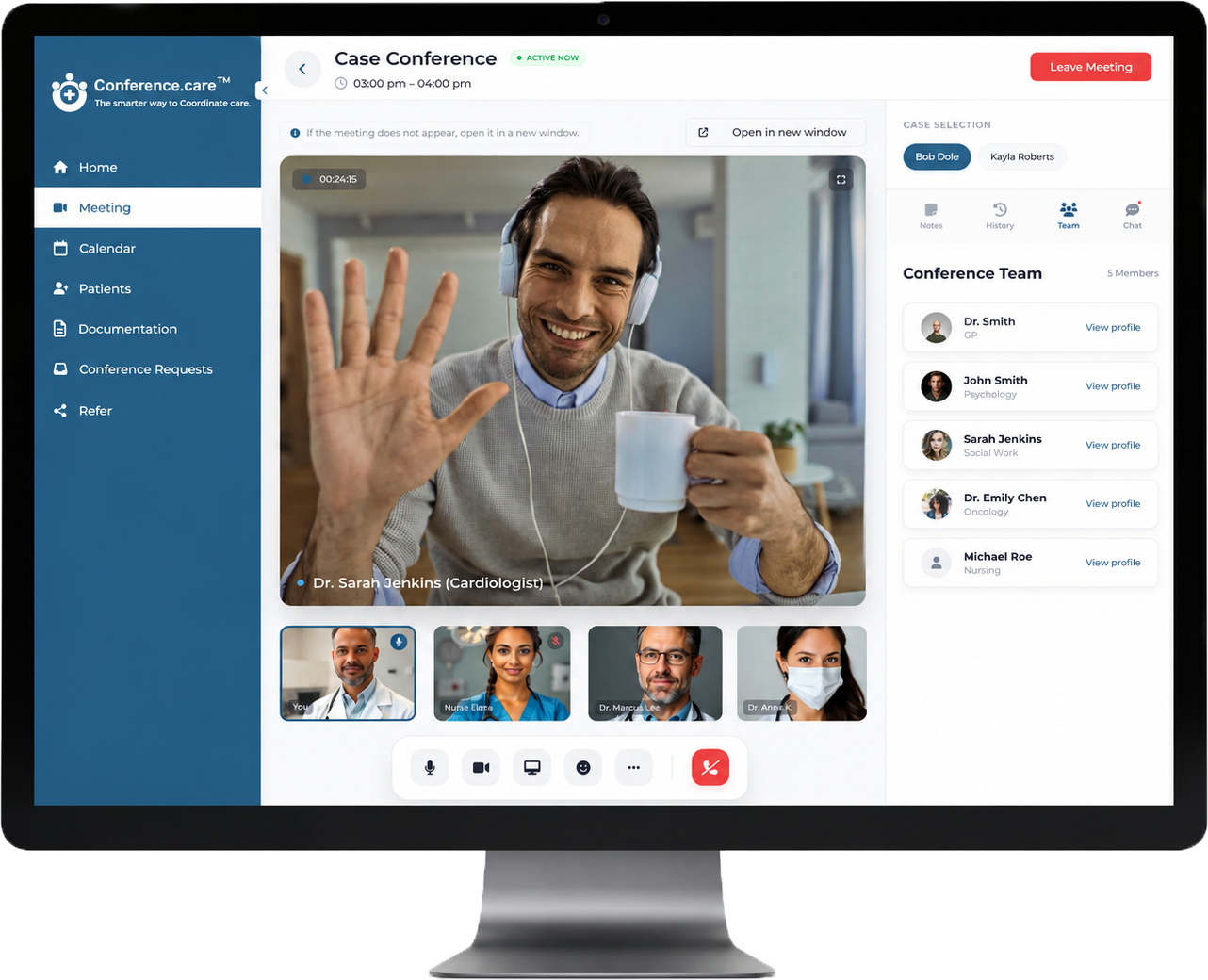
It's a scheduled conversation about one patient — you, plus specialists, allied health and mental health clinicians. Brief them on the case; benefit from the insight of discipline-specific advice. You come away with a clearer view of what's driving the presentation, and what to do about it.
You know your patients best, so simply tell us what that patient needs. Conference.care then helps you bring together the specialists and allied health best suited to the case, and run it to the standard Medicare sets.

Common cases
These cohorts benefit most — but any patient with a chronic condition or in residential aged care is eligible for a GP-coordinated case conference.
Falls risk, polypharmacy, cognitive decline, frailty, dementia, Parkinson's.
Osteoarthritis, chronic low back pain, fibromyalgia, CRPS, neuropathic pain.
Blood glucose instability, poor adherence, limb ischaemia, neuropathy.
Heart failure, post-stroke care, atrial fibrillation, hypertension.
Treatment-resistant depression, PTSD, bipolar disorder, eating disorders.
Why GPs use Conference.care
Complex patients don't fit in a standard consult. A case conference connects you with the clinicians you'd otherwise be referring to — and lets you consult with them in real time.
Several disciplines weigh in on your most complex patient at once, instead of you chasing opinions one letter at a time.
Ask the endocrinologist directly, instead of writing a referral and waiting on a letter.
Conference time is rebated up to $456.60 an hour, depending on how you structure it — comparable to or better than a standard consulting hour.
The team documents together while you talk, so the record is written by the time the conference ends.
Work with the same specialists and allied health each time, so nobody starts from scratch. That accumulated understanding of your patients sharpens every conference — and the care that follows.
Several disciplines looking at one patient surface what a single vantage point misses — while there is still time to act on it.
The evidence
Studies consistently show that when care teams meet like this, patients' problems are picked up earlier, care plans work better, and hospital visits go down.

of Australian patients in a recent study believe case conferences had a positive effect on their care.
Across many health settings, research consistently shows case conferences:
What does it take?
Setting up a case conference means finding the right disciplines, arranging a time that suits everyone, and pulling the notes together afterwards. None of it fits between patients — which is why it rarely happens. At Conference.care, we handle the admin, so you can focus on the patient’s care.
How it works
From finding a time that suits everyone to claiming the item number — here's the whole thing.



Your team, all the way
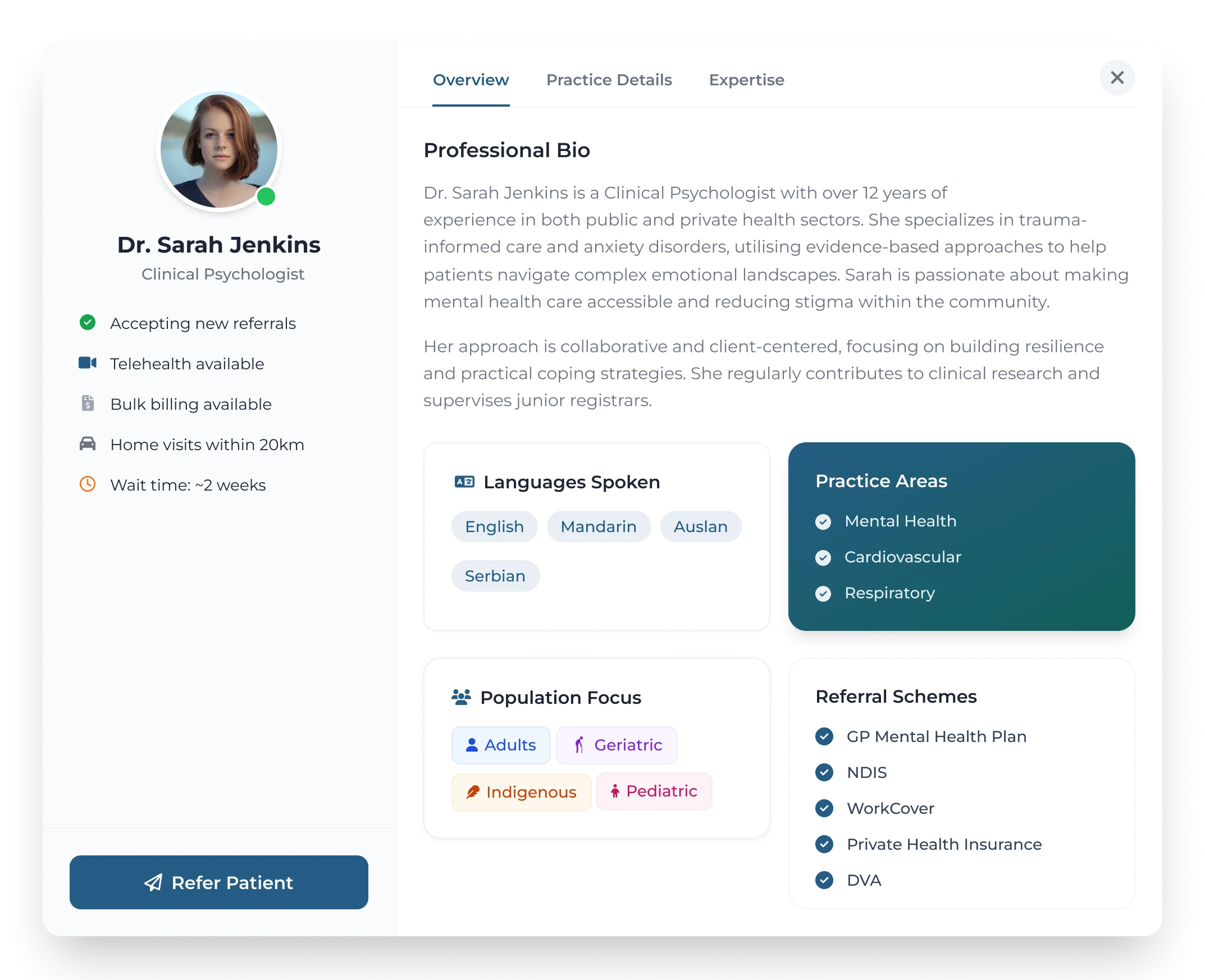
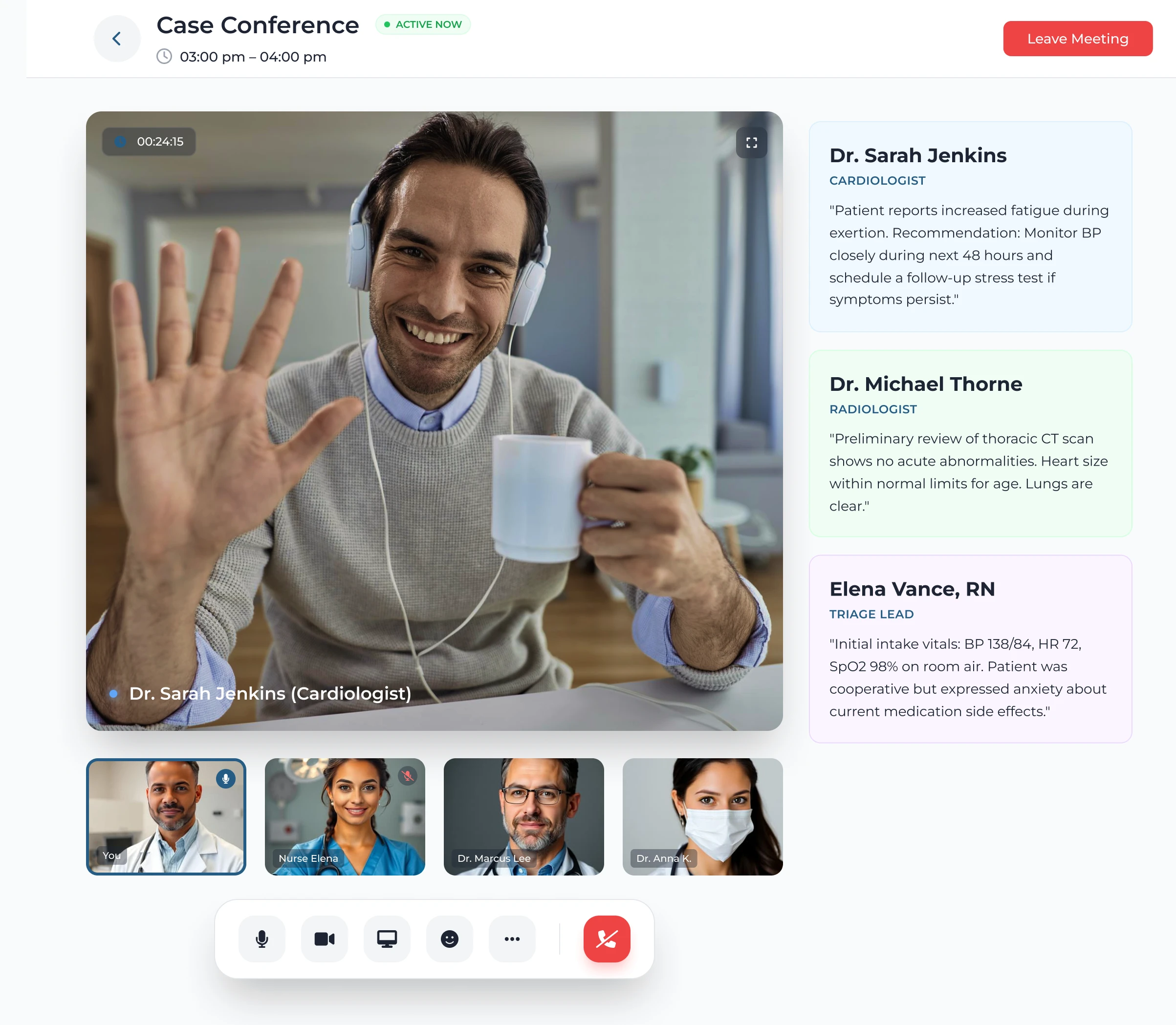
Tell us what your patient needs and a team is brought together from our clinician network to match. Want particular specialists — including ones you already work with? Say so, and we'll ensure they are present on your regular roster.
Book a pilot conferenceWhat's it worth?
Case conferences are rebated across private, mixed and bulk-billing practices. Move the slider to see what adding them to your week is worth.
Models 3 × 20 min per hour (MBS items 739/743 plus the bulk-billing incentive, item 10990, MM1), over 46 working weeks. Other combinations across the three time tiers — 15, 20 and 40 minutes and up — give a different figure. Indicative only — not financial or clinical advice. Conference duration, frequency and composition remain clinical decisions for the coordinating practitioner.
Good for your patients, good for you
The RACGP lists multidisciplinary case conferences as a Reviewing performance activity — the category most GPs find hardest to fill, and the one the Medical Board pushed to the centre in 2023 when it shifted CPD toward peer collaboration, feedback and reflection.
Conference time counts as Reviewing performance, hour for hour — a category that can fill up to 32.5 of your 50 annual hours.
A short reflection after each conference and your record is ready — and it’s maintained for the required three-year audit window.
Scan the code to pre-fill a Quick Log entry in your myCPD app, with the evidence on screen ready to attach.
Case conferencing is Reviewing performance only. Educational Activities and Measuring outcomes hours still apply, and Conference.care is not currently an RACGP-approved CPD provider — these are self-recorded activities. Requirements are the RACGP’s and may change; check your own CPD home.
100% free for GPs
There isn't one. No subscription, no per-conference charge, and we never take a cut of your rebate. Our allied health team is funded from their own billings, not yours. You spend your time on the clinical discussion; we look after everything else.

No subscription, no per-conference charge, no hidden fees — ever.
You claim the item through your usual channels. We never take a percentage.
If your practice isn't running telehealth yet, our team will get you going.
Who’s behind it
Conference.care was founded and is run by Australian GPs. You get direct access to that team for help with the clinical, administrative and Medicare-compliance side of case conferencing — whenever you need it.

Co-founder · FRACGP General Practitioner

Advisory board · Former RACGP federal president
Head of Allied Health · Physiotherapist

Psychologist
Compliance & security
Developed in consultation with Avant Law, the legal arm of Australia's largest medical defence organisation, so compliance is handled as a forethought, not an afterthought.
What GPs say
Practices across Australia, in their own words.
As a newly fellowed GP, I cannot speak highly enough of the service. The advice and expertise of each clinician is invaluable, and the team makes it incredibly easy to engage — the technology is both accessible and effective.

Conference.care has transformed case conferences from a frustrating task into a streamlined, high-value process. I've even had patients sit in, ask questions and take ownership of their health. This feels like what healthcare was meant to be.

As a specialist GP passionate about comprehensive care, I'm very impressed with the collaborative care support offered. They've made the entire experience seamless — and made multidisciplinary care enjoyable and simple.
Frequently asked
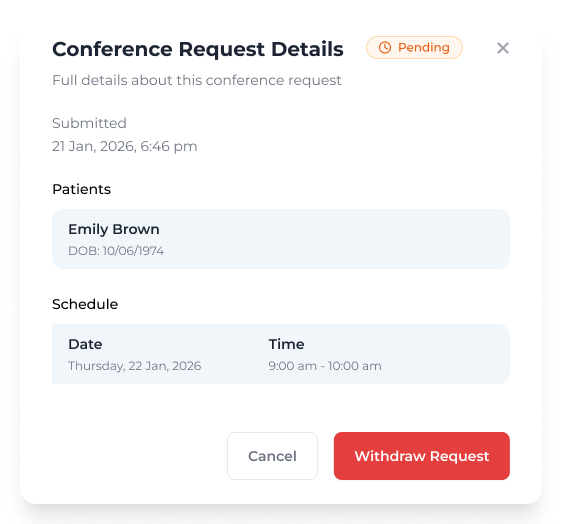
The platform logs the duration and prompts the correct item number at the end of the conference. You submit the claim through your usual channels, the way you always have.
Clinical information is shared verbally or by screen-share during the conference. Calls aren't recorded or transcribed, so none of it is stored.
As long as the patient’s presentation calls for. The item tiers start at 15 minutes and there’s no upper limit — how long a case needs is your clinical judgement, not ours. It runs on secure video from your consulting room or from home, in any browser — nothing to install — and if your practice isn’t set up for telehealth yet, we’ll get you going. GPs often book a single block and cover more than one patient in it; how you structure it is your call.
Usually not — you take the outcome back to your patient at their next consult. Some GPs do invite patients to sit in, and find it helps them take ownership of their care.
We have clinicians in every state and territory. If your area is thin, our team reaches out to local specialists and allied health when you sign up.
Composition is always your call. Most GPs tell us what the patient needs and a team is brought together from our clinician network to match — and many then run the same slot with the same clinicians every week. If you’d rather have particular specialists or allied health, including someone you already work with who isn’t on Conference.care yet, tell us and we’ll arrange it.
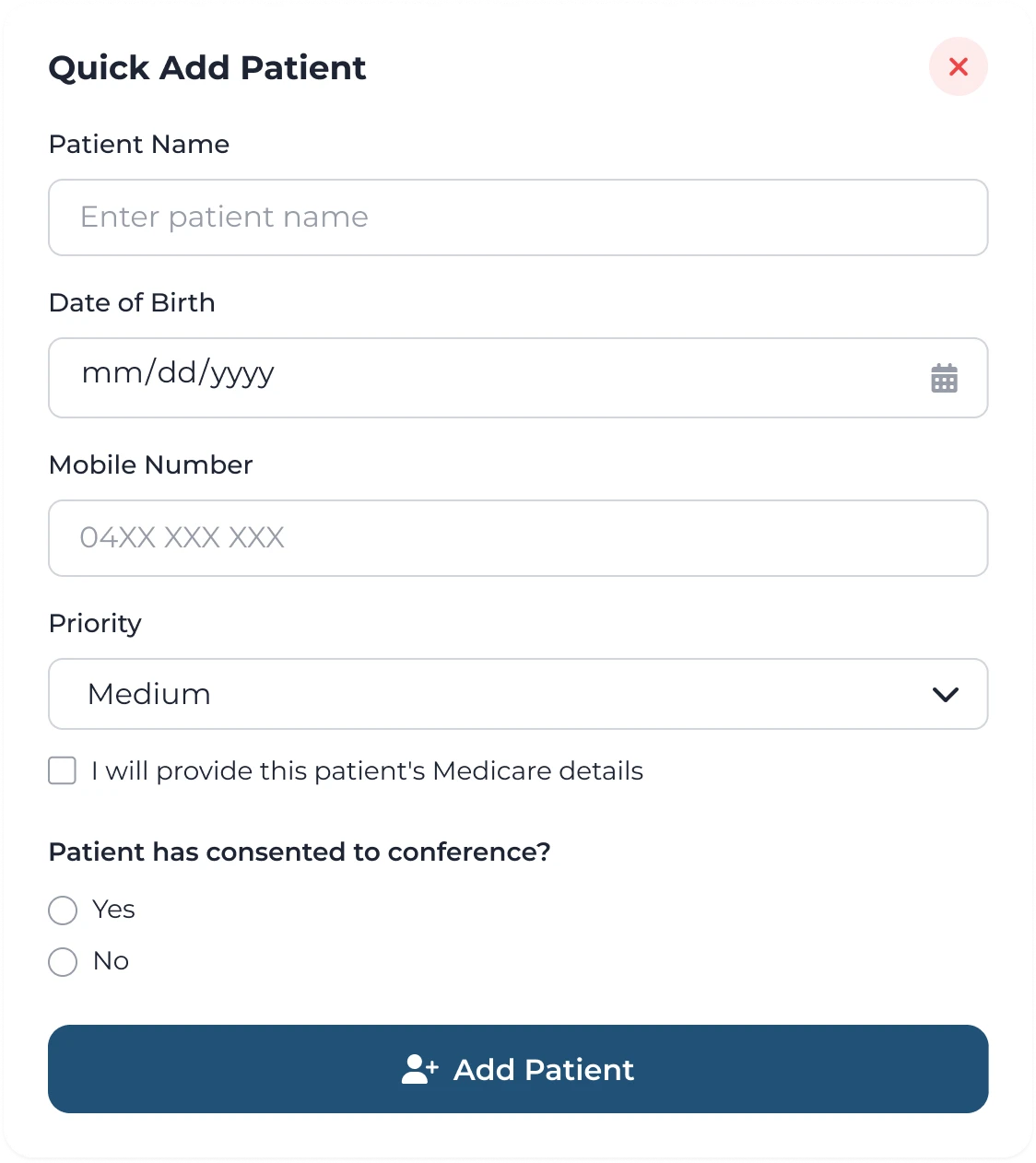
The conference is as long as the case needs — the shortest item tier starts at 15 minutes. Around it, you name the patient and say what input they need — a minute, when you add them. Afterwards you talk the outcome through at their next consult and drop the summary into your records. The consent, the invitations, the diary wrangling and the write-up aren’t yours.
Fair question, and the honest answer is that it’s the whole product. Clinicians are recruited against a standard, then continually evaluated and supported — on the quality of what they bring to a case, not on how many they’ll take.
Their own, wherever they have them — name the providers when you add the patient and the invitations go out to them. Where nobody’s available in a discipline the case calls for, our clinical team brings someone in. Medicare allows for exactly that: the explanatory note for these items states that “the health professional is not required to have a pre-existing relationship with the patient”, and that a referral isn’t required either. They advise you; whether anyone ends up treating your patient is your call.
Three, and worth knowing upfront. It’s for patients with chronic or complex needs — an acute presentation isn’t suitable. The patient has to agree to the conference, and we give you the leaflet and the prompts for that conversation. And the allied health participation items can’t be claimed within three months of the last one unless the patient’s condition or circumstances have changed significantly — scheduling accounts for that.
Then you’ve spent one short conference finding out, and you know. There’s nothing to cancel, nothing to unwind and nothing owing. We’ll help you pick a patient likely to benefit for the first one, which is usually the difference between a conference that lands and one that doesn’t.
Book a pilot case conference: pick a chronic-disease patient, and our clinical team joins you for a 40-minute discussion you can claim. No cost, no commitment, and you keep the rebate.
Prefer to talk it through first? Call 02 9173 8555 during business hours (AEST), or get in touch via the contact page.